How to Spot a Fake Online Store: 14 Warning Signs (2026)
Fake online stores are one of the most common ways people lose money online. They look like real shops, run ads on Facebook, Instagram and TikTok, take your payment, and then send nothing, send a cheap copy, or disappear. The good news: almost every fake store makes the same mistakes. Here are the 14 warning signs to look for before you place an order.
The 5 biggest signs of a fake online store
- Prices 50 to 90% below every other shop
- The website was created only weeks or months ago
- Payment only by bank transfer, crypto or gift card
- No real company name, address or phone number
- No independent reviews, or reviews saying orders never arrived
Warning signs in the deal itself
1. The price is far too low
Branded shoes, phones, perfumes or designer bags at a fraction of the normal price are the most common bait. Search the same product on two or three well-known stores. If everyone else charges full price and one unknown site sells it at 70% off, the discount is the trap.
2. Constant “closing down” or “clearance” sales
“Store closing, everything must go” and “final clearance” banners create a reason for impossible prices. Many fake stores use the same story, sometimes with the name of a real local shop that never closed.
3. Countdown timers and “only 2 left”
Timers that restart when you reload the page, and stock counters that never change, are designed to make you pay before you think. A real store doesn’t need to rush you.
Warning signs on the website
4. A very new domain
Look the domain up on ICANN Lookup. Fake stores are usually registered a few weeks or months before the ads start, and often for one year only. A store that claims a long history on a brand-new domain is not being honest.
5. A strange or misspelled web address
Look for an extra letter, a hyphen, or a brand name with words like “outlet”, “sale” or “official-store” added. Unusual endings such as .shop, .top, .store or .online are not scams by themselves, but they are common on fake shops copying a well-known brand.
6. Stolen product photos
Search a product image with Google Lens or TinEye. If the same photo appears on the brand’s official site or on dozens of other shops, the store probably doesn’t have the product at all.
7. Copied text and broken pages
Spelling mistakes, product descriptions that don’t match the item, menu links that go nowhere, and policy pages that mention a different store name are signs the site was built in a hurry from a template.
8. No real contact details
A contact form or a free email address is not enough. A real shop shows a company name, a physical address and a phone number. Search the company on OpenCorporates and paste the address into Google Maps to see whether it exists.
9. A refund policy you can’t use
No returns policy, or one that only allows returns to an overseas address at your cost, means you will never get your money back by asking. Read it before you buy, not after.
Warning signs at checkout
10. Unsafe payment methods only
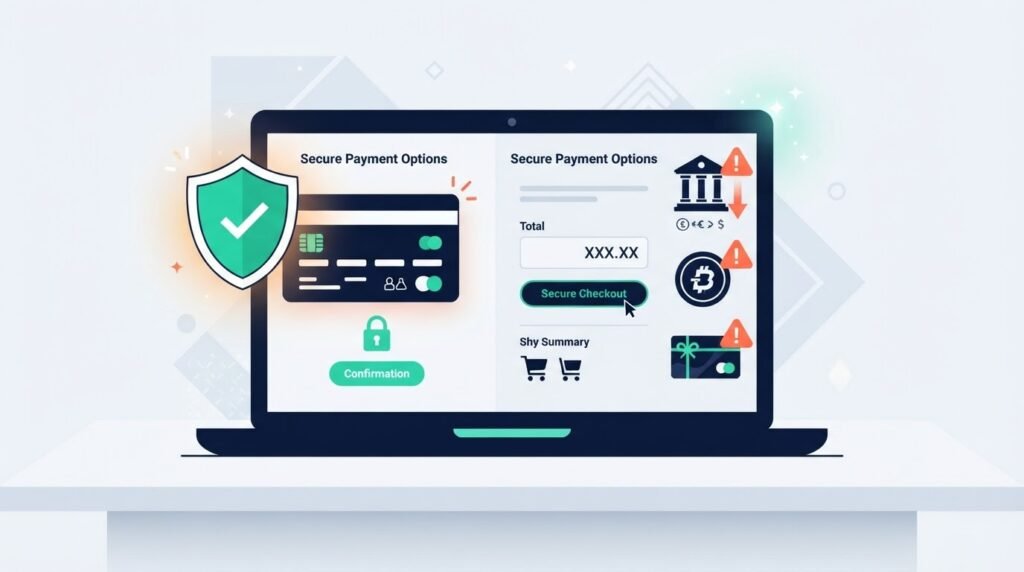
Go to checkout without paying and look at the options. If the store only accepts bank transfer, cryptocurrency, gift cards or payment to a personal account, stop. These payments are almost impossible to reverse. Card and PayPal payments can be disputed.
11. A card payment that “fails” and asks for another method
Some fake stores show a card form that always errors out, then offer a “discount” if you pay by bank transfer instead. That switch is the scam.
Warning signs outside the website
12. No independent reviews, or bad ones
Search the store on Trustpilot, Sitejabber and Reddit. No reviews at all is common for fake stores because they don’t last long. Reviews mentioning “never arrived”, “wrong item” or “no reply” are the clearest warning you will get.
13. A social media page with comments turned off
Many fake stores find buyers through ads. Check the page behind the ad: when was it created, does it have real posts, and are comments hidden? Search the store in the Meta Ad Library to see how many ads it runs and how new the page is.
14. A low score on a safety check
Paste the store’s address into the SosoVibe website checker. It brings domain age, SSL, blacklist results and user reviews into one report, so you can see several of the signs above at once.
What to do if you already ordered from a fake store
- Contact your bank or card provider straight away and ask for a chargeback or dispute. With PayPal, open a dispute in the Resolution Center.
- Keep everything: the order confirmation, emails, screenshots of the site and the ad, and your payment receipt.
- Don’t pay anything else, such as “customs fees” or “shipping insurance” the store asks for later.
- Report it to your local cybercrime authority, to the platform that showed you the ad, and on SosoVibe to warn other shoppers.
Frequently asked questions
How can I check if an online store is real?
Check the domain age, look for a registered company and real contact details, read independent reviews, and make sure you can pay by card or PayPal. Our full guide on how to check if a website is legit walks through all 12 checks.
Are stores on Instagram and Facebook ads safe?
Some are, many aren’t. Ads are easy to buy, so an ad tells you nothing about whether a store is real. Check the store’s website and reviews before you order.
Can I get my money back from a fake online store?
If you paid by card or PayPal, you can often dispute the charge, so act quickly. Bank transfers, crypto and gift cards are much harder to recover.
Found a store and not sure?
Check it free before you order.